
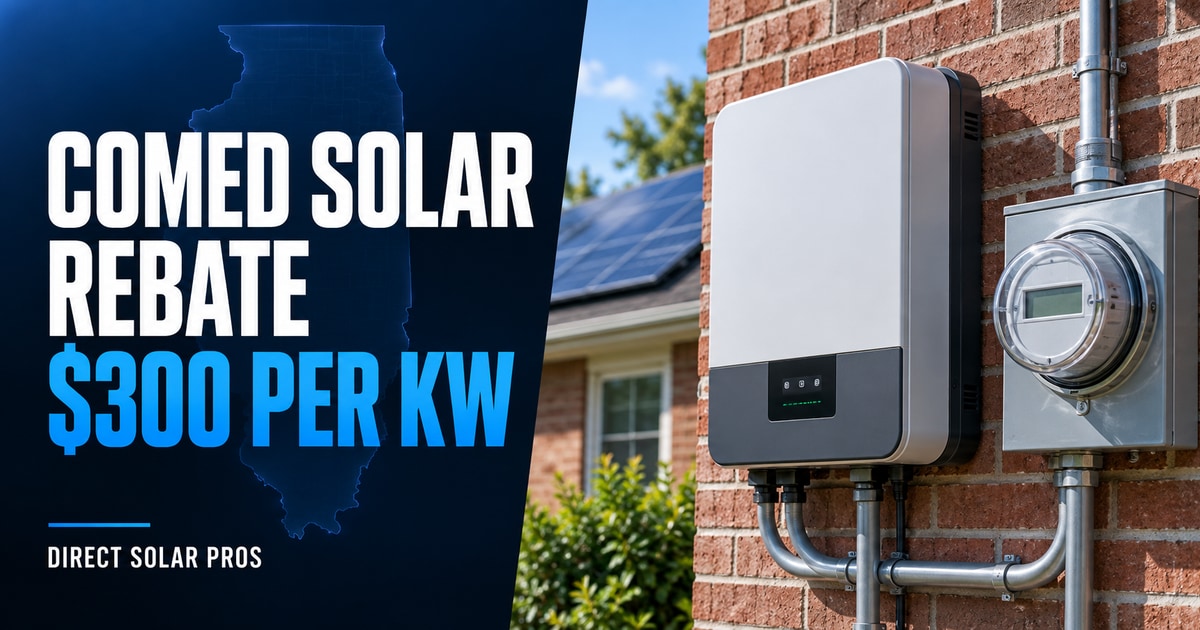
Of all the money available to an Illinois homeowner going solar, the ComEd solar rebate is the easiest to understand and the easiest to lose. It is a single check, the math takes ten seconds, and it arrives a few months after your system turns on. It is also tied to a piece of equipment most people never think about and a filing that has to happen in the right order, and we have seen homeowners forfeit a few thousand dollars because nobody told them either of those things. This is the short, complete version.
What the ComEd DG rebate is
ComEd calls it the Distributed Generation Rebate, and you will also hear it called the DG rebate or the smart inverter rebate. All three names mean the same program. It is a one-time payment from ComEd, required under Illinois law, to customers who connect a solar system to the grid using a smart inverter.
For residential and small commercial customers, the rebate is $300 for every kilowatt of DC solar capacity you install. A 7.5 kW system earns $2,250, a 10 kW system earns $3,000, and a 12 kW system earns $3,600. Larger commercial and industrial systems earn $250 per kilowatt instead, and the program caps out at 5,000 kW of capacity, which no house will ever approach. See ComEd's rebate terms and conditions.
This is a check from ComEd, mailed to you after approval. It is not a bill credit and not a discount your installer applies at signing, so if a quote shows it as a line item reducing the price, ask how that is being handled. Ameren offers a matching $300 per kW rebate downstate with its own application, so the numbers in this post apply across most of Illinois even though the paperwork differs. See Ameren's current rebate resources.
Who qualifies
The requirements are short but strict. Your system has to be connected to ComEd's distribution grid under the interconnection rules set by the Illinois Commerce Commission, it has to be primarily intended to offset your own electricity use rather than to sell power, and you have to be a current ComEd delivery customer at the address.
The requirement that trips people up is the inverter. The rebate exists because Illinois wants solar systems that can help stabilize the grid, and that help comes from the inverter, the box that converts your panels' DC output into the AC power your house uses. To qualify, your inverter has to be on the state's approved smart inverter list and has to be configured to ComEd's published settings, which allow it to respond automatically to voltage and frequency swings on the grid. By accepting the rebate you agree to let ComEd rely on those settings for grid support for the life of the system.
Nearly every inverter sold in 2026 is a smart inverter, so the equipment itself is rarely the problem. The problem is configuration. If the installer leaves the inverter on factory defaults instead of the ComEd-required profile, the rebate application fails. Make sure whoever installs your system confirms in writing that the inverter is set to ComEd's DG rebate settings before they leave.
When and how to apply
Order matters here. The rebate application is filed after your system is interconnected and has received permission to operate from ComEd, not before and not at the time you sign. The application goes through ComEd's online DG rebate portal and needs your interconnection details, the inverter make and model, and the system's DC nameplate capacity. Most installers file it on the homeowner's behalf as the last step of the project, but not all do, and a surprising number of homeowners assume it happened when it did not.
Ask your installer directly whether they file the rebate application and when. If they do not, file it yourself as soon as ComEd issues permission to operate, because there is no benefit to waiting and every reason not to let it slip. ComEd reviews the application, verifies the inverter settings against its records, and issues the check, which typically arrives within a couple of months of approval.
The net metering trade
There is one condition attached to the rebate that mattered a great deal until recently and matters less now. Under Illinois law, a customer who takes the DG rebate agrees to be billed under net billing rather than full retail net metering. Before 2025 that was a real decision, because full net metering was worth more than the rebate for many homes and taking the check meant giving it up.
Since January 1, 2025, every new solar customer in ComEd territory is on net billing anyway, so there is nothing left to trade. The rebate became a straightforward yes for anyone connecting in 2025 or later, and the smart inverter rebate is in effect the state's way of compensating for the switch. The only homeowners who still face a real choice are those who connected before 2025 and are grandfathered into full net metering, and for them taking the rebate on an expansion or a battery can mean losing that status, so it deserves a careful look before filing. Our net billing guide explains what that switch means.
The battery rebate
ComEd runs a companion rebate for home batteries paired with solar, and it is worth more than the solar rebate for many households. It pays $300 per kilowatt-hour of battery capacity, so a 10 kWh battery earns $3,000 and a 13.5 kWh battery earns just over $4,000, on top of the solar rebate for the same system.
The condition is that you switch your electricity supply to ComEd's Rate BESH, which is the residential hourly pricing rate, and stay on it for the life of the battery. Hourly pricing means your supply cost moves with the wholesale market throughout the day, which is good for a home with a battery that can charge when prices are low and discharge when they spike, and less good for a home that cannot shift its usage. For most solar-plus-battery households the rate change is a benefit rather than a cost, but it is a permanent commitment and should be understood before signing. Ameren offers the same $300 per kWh with enrollment in one of its peak-time programs instead.
How it stacks with Illinois Shines
The ComEd rebate, Illinois Shines, and net-billing credits are three streams with different rules, and more than one may apply to the same qualifying system. Illinois Shines uses REC contracts, explained in our Illinois Shines explainer, while the ComEd rebate is tied to eligible smart-inverter capabilities. Do not simply subtract all three from a quote: confirm rebate approval, REC customer value in the Disclosure Form, utility treatment, and monthly credit assumptions. Our Illinois solar cost guide shows how to compare them against a real system price.
What to do before your system turns on
Confirm that your inverter is on the state's approved list and that the installer will configure it to ComEd's rebate settings. Confirm in writing who files the rebate application and when. If you are adding a battery, decide whether Rate BESH suits your household before committing. And if you are a pre-2025 net metering customer, talk to someone who understands the grandfathering rules before touching the rebate.
We handle all of this for the homeowners we work with, including confirming inverter settings with our installation partners and filing the ComEd application once permission to operate is issued. If you want to see how the rebate fits into the full picture of whether solar is worth it in Illinois for your house, schedule a free consultation and bring a recent ComEd bill.
Program details checked September 17, 2026. Rebate amounts, eligibility, and tariff requirements are set by the utility and can change. Confirm current terms before relying on any figure here.
Frequently asked questions
How much is the ComEd solar rebate?
$300 per kilowatt of DC solar capacity for residential and small commercial customers, paid as a one-time check. A 7.5 kW system earns $2,250 and a 10 kW system earns $3,000. Larger commercial systems earn $250 per kW. Amounts and eligibility depend on current program terms at the time your application is approved.
When do I apply for the ComEd DG rebate?
After your system is interconnected and ComEd has issued permission to operate. The application goes through ComEd's online DG rebate portal and is usually filed by your installer, but confirm that rather than assume it.
What is the smart inverter requirement?
Your inverter must be on Illinois's approved smart inverter list and configured to ComEd's published DG rebate settings so it can support the grid during voltage and frequency events. Most 2026 inverters qualify, but the settings have to be applied at installation.
Does taking the ComEd rebate affect net metering?
Taking the rebate means being billed under net billing rather than full retail net metering. Since all new ComEd solar customers have been on net billing since January 1, 2025, this only matters for homeowners grandfathered into full net metering before that date.
Is there a ComEd rebate for solar batteries?
Yes. ComEd pays $300 per kilowatt-hour of battery capacity paired with solar, so a 13.5 kWh battery earns about $4,050. You must enroll in ComEd's Rate BESH hourly pricing plan and stay on it for the life of the battery.