
Consider a homeowner in Schaumburg who turns on a new solar system in March and spends the next three months convinced something is broken. The panels produce almost exactly what the installer projected. The bill is lower, but not as low as the neighbor's, whose nearly identical system went live two years earlier. Nothing is broken. The two houses are on two different sets of rules, and nobody explained the difference.
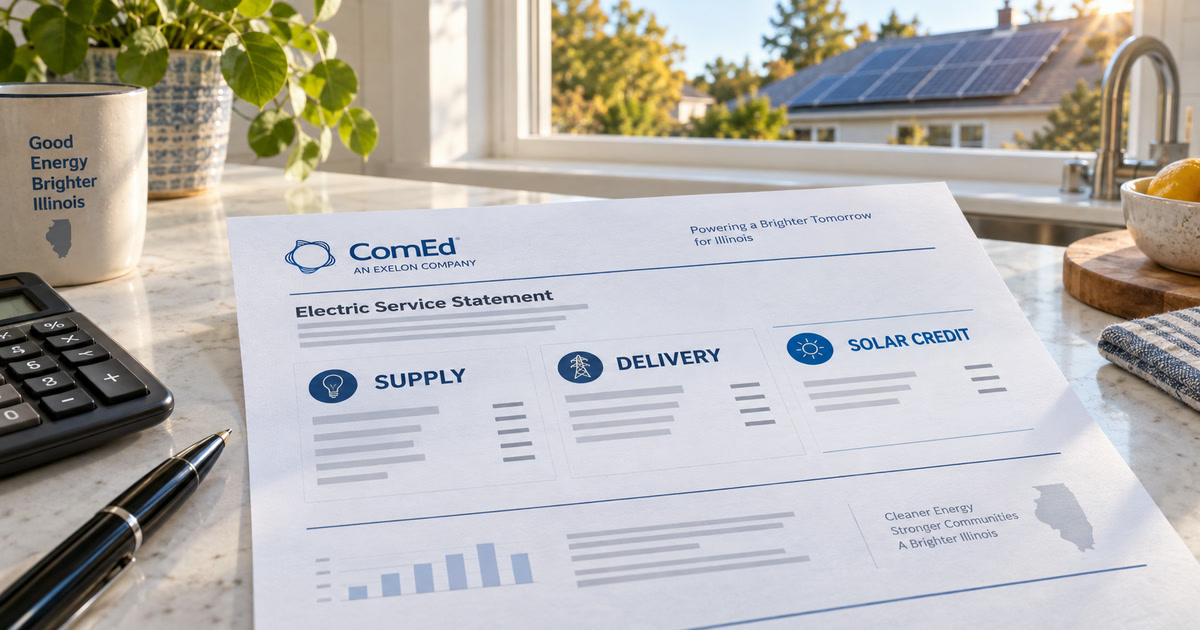
If you are searching for ComEd net metering in 2026, the first thing to understand is that full-retail net metering closed to new customers after 2024. ComEd still uses the term net metering for the program, but the post-2024 credit structure is commonly described as net billing or supply-only net metering. It changes how a solar system should be modeled, used, and judged.
What changed on January 1, 2025
Under the earlier Illinois rules, eligible ComEd solar customers could receive full-retail net-metering credits. Excess generation could offset the supply, delivery, and taxes-and-fees portions of the bill. A kilowatt-hour sent to the grid could therefore carry substantially more value than it does for a new customer today.
The Climate and Equitable Jobs Act set a January 1, 2025 transition. Eligible residential and small-commercial systems interconnected before that date retain legacy full-retail treatment for the life of the system, subject to ComEd's tariff and account-transfer requirements. Systems interconnected on or after that date receive credits that offset supply-side charges rather than the full retail bill. ComEd's current net-metering FAQ explains the distinction.
The practical difference is simple: electricity used inside the home while the panels are producing can avoid applicable retail purchases, including delivery-related usage charges. Electricity exported and credited later generally offsets supply-side charges only for a non-legacy customer. Those two kilowatt-hours no longer have the same economic value.
For context, the Illinois Commerce Commission listed ComEd's Price to Compare at 10.399 cents per kilowatt-hour from June 1 through September 30, 2026. That is a comparison rate, not a promise that every exported kilowatt-hour earns exactly that amount. The actual credit depends on the customer's supply service, tariff, billing period, and whether the account uses fixed, hourly, time-of-use, or competitive supply. Check the ICC's current supply comparison.
How ComEd calculates the credits
The calculation depends on the supply option. For a customer buying fixed-price supply from ComEd, inflows and outflows are generally netted over the billing period for supply purposes. A non-legacy customer may elect eligible credits in kilowatt-hours or as a monetary credit, while the bill still charges for electricity delivered from the grid under the applicable delivery rules.
Hourly-pricing customers are different. Their monetary credits are based on the price of power during the hours when excess electricity is exported. That means the value can change hour by hour. ComEd's solar and hourly-pricing guide explains that credits are calculated when the excess generation occurs.
In either structure, power produced and consumed behind the meter never becomes an export. It reduces the amount the home needs to purchase from the grid, which is why direct self-consumption generally has more value than exporting under the post-2024 rules.
One useful feature came with the change: ComEd says credits for customers interconnected on or after January 1, 2025 do not expire. Unused credits can carry into later billing cycles. Some legacy fixed-price customers still have annual expiration rules for banked kilowatt-hour credits.
That carryforward can matter when summer production runs ahead of winter production, but it does not eliminate fixed charges or guarantee that one season's credit balance covers another season's bill.
Customers who buy supply from an alternative retail electric supplier should verify how that supplier handles solar credits. ComEd's delivery tariff does not guarantee that every competitive supplier will value or present the supply credit in the same way.
The rebate that came with the change
Illinois also provides a distributed-generation rebate tied to qualifying smart-inverter systems. For residential and small commercial ComEd customers, the current base rebate is $300 per kilowatt of eligible DC generating capacity. A qualifying 7.5 kW system would therefore receive $2,250, subject to the current equipment, interconnection, application, and tariff requirements.
The rebate was designed in the same policy transition that moved new customers away from full-retail credits. Since customers interconnecting now already receive supply-only credits, the rebate can materially improve the project economics, but it should not be counted until eligibility and filing responsibilities are confirmed. Our ComEd rebate guide covers the smart-inverter requirement and application order.
The tradeoff matters most for legacy customers. A homeowner with pre-2025 full-retail status can lose that treatment by electing the rebate or making certain changes to the system. Anyone in that position should verify the effect before filing or modifying the array.
What net billing means for system design
Under the old full-retail structure, exported production could offset more of the bill. Under supply-only crediting, every kilowatt-hour exported at a lower value and bought back later at the applicable retail rate creates a value gap.
The new priority is self-consumption. A system modeled against the household's actual usage pattern can keep more production inside the home, where it avoids grid purchases. Shifting flexible loads into daylight hours can help for the same reason. Running the dishwasher or dryer during the day, charging an electric vehicle while the panels are producing, or pre-cooling the house before evening can reduce lower-value exports.
Roof orientation can also affect the timing of production. West-facing panels may produce later in the day, when some homes use more electricity, while south-facing panels often maximize total annual production. The better choice depends on shade, available roof planes, the household's load shape, and the applicable rate—not a universal rule.
A home that is empty during most daylight hours may export a larger share of production. That does not automatically make solar a poor fit, but it makes the export assumption and system size more important than they were under full-retail net metering.
Batteries and hourly pricing
A battery changes the net-billing calculation by storing midday surplus for later use. Instead of exporting that energy at a supply-side value, the home can use it after sunset to reduce purchases from the grid. Whether the extra avoided cost justifies the battery's installed price is a separate calculation.
ComEd currently offers qualifying residential and small-commercial storage a rebate of $300 per kilowatt-hour of eligible nameplate capacity. A 13.5 kWh battery could therefore qualify for about $4,050. Current program terms also require the storage customer to remain on an eligible flexible or time-variant supply option for the life of the storage system; ComEd's published terms identify Rate BESH hourly pricing as a qualifying path. Review ComEd's rebate terms.
Hourly pricing can reward a home that shifts consumption away from expensive hours, and exported solar receives the hourly market value when it is generated. It can also expose the customer to higher prices during expensive periods. Solar, storage, and load controls can help manage that risk, but savings are not guaranteed. Our Illinois solar cost guide puts the battery cost and rebate into the larger project budget.
What net billing does not change
Illinois Shines is unaffected by the export calculation. Its REC contract value is based on approved project production and program terms, not on whether each kilowatt-hour is used inside the home or exported. The customer's Disclosure Form and agreement determine how that value reaches the homeowner. Our Illinois Shines explainer covers those mechanics.
The value of direct solar consumption also remains. When the home uses panel production in real time, that energy can reduce electricity purchases from the grid. Fixed customer charges and other non-bypassable bill items can remain, so a solar proposal should estimate the post-solar bill rather than promise that it disappears.
Legacy customers have something valuable to protect. ComEd's approved framework preserves eligible full-retail treatment for the system's lifetime, including after a home sale if the successor customer completes the required assignment process. System modifications, rebate elections, supplier changes, and transfer paperwork should be checked against the current tariff before action is taken.
What to ask before you sign
Ask any company quoting a system to show the production estimate split between electricity consumed inside the home and electricity exported. A model that values every generated kilowatt-hour at the full retail rate is using assumptions that do not fit a new ComEd customer.
Ask which supply service the projection assumes, whether credits are modeled in kilowatt-hours or dollars, and whether any hourly or time-of-use rate is included. Ask how a battery would change the export percentage and total project cost. If you already have pre-2025 solar, ask what any expansion, storage addition, rebate election, or ownership transfer would do to your legacy status.
We size systems for Illinois homeowners around the rules that apply now, and we show the export and self-consumption assumptions before a decision is made. If you want to see how net billing changes whether solar is worth it in Illinois for your house, schedule a free consultation and bring a recent ComEd or Ameren bill.
Program details and rates checked September 23, 2026. Utility rates, tariffs, rebate requirements, supplier treatment, and credit calculations can change. Confirm current terms for the specific account before relying on any figure.
Frequently asked questions
Did ComEd get rid of net metering?
Full-retail net metering closed to new customers after 2024. Systems interconnected on or after January 1, 2025 receive credits that offset the supply portion of the bill rather than supply, delivery, taxes, and fees. Eligible systems connected before that date retain legacy full-retail treatment, subject to current tariff requirements.
How much does ComEd pay for excess solar under net billing?
The value depends on the customer's supply option. Fixed-price ComEd customers receive supply-side credits under the applicable monthly rates, hourly-pricing customers receive monetary credits based on the price during the hours of export, and customers using another supplier must confirm that supplier's credit treatment. Delivery charges are not offset for non-legacy customers.
Do net billing credits expire?
ComEd says net-metering credits do not expire for customers interconnected on or after January 1, 2025. Some legacy fixed-price customers still have annual expiration rules for banked kilowatt-hour credits.
What is the difference between net metering and net billing?
Legacy full-retail net metering credits eligible exports across supply, delivery, taxes, and fees. The post-2024 structure credits eligible exports against supply-side charges only. Fixed-price and hourly-pricing customers also have different valuation mechanics.
Is solar still worth it in Illinois under net billing?
It can be, but the answer is home-specific. Electricity used directly from the panels can avoid applicable retail purchases, while exports generally receive a lower supply-side value. Project price, daytime usage, roof production, financing, remaining utility charges, rebates, and Illinois Shines terms all matter.