
Every January, a new solar owner somewhere in Illinois opens the production app on a gray afternoon, sees a fraction of the July output, and wonders whether the system is working. Then a bright, bitter morning arrives and the same array posts a surprisingly strong hourly number.
Both readings can be normal. Solar panels work in winter and cold temperatures can improve conversion efficiency. Illinois winter production is lower mainly because the days are shorter, the sun is lower, skies can be cloudier, and snow may temporarily block the light.
Cold helps efficiency. Less light reduces energy.
Solar panels convert light into electricity, not heat. The U.S. Department of Energy explains that solar cells generally perform best at lower temperatures because higher cell temperatures reduce voltage. Panel specifications express this behavior through a temperature coefficient measured against standard test conditions.
That does not mean a cold January day automatically produces more energy than a July day. Temperature affects how efficiently the panel converts the light that reaches it. Winter still supplies fewer total hours of sunlight, a lower solar angle, and often more diffuse light through cloud cover. Those seasonal effects usually outweigh the cold-weather efficiency benefit across an entire month.
A clear winter hour can therefore look excellent while the full winter day remains below a long summer day. The Department of Energy explains how temperature affects photovoltaic efficiency.
Snow is a temporary production problem
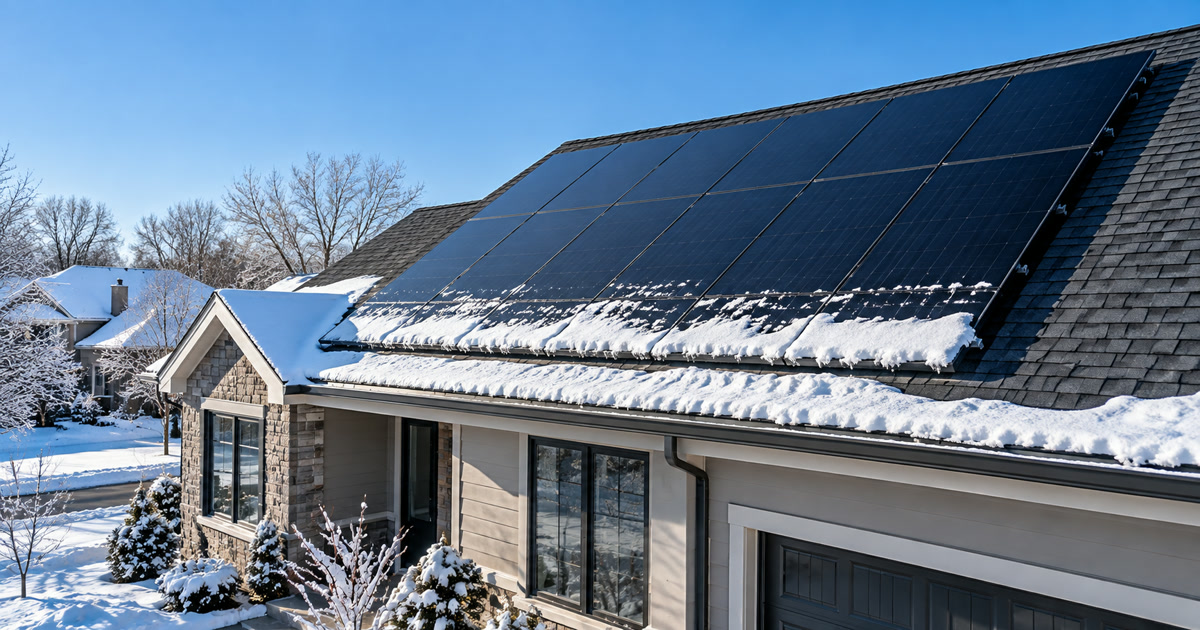
A panel fully covered by opaque snow has little or no useful light reaching its cells, so production can drop sharply until the array clears. Snow often melts, slides, or blows off tilted panels after conditions improve, but it is not responsible to promise that every roof will clear within a specific number of hours. Temperature, sunlight, wind, roof pitch, panel layout, and the character of the snowfall all matter.
Fresh snow around a cleared array can reflect additional light toward the panels, an effect called albedo. That can help production under the right conditions, but it does not erase the loss from snow that remains on the panel surface.
For most homeowners, the right snow-removal plan is to wait. The Department of Energy says removing accumulated snow or ice is generally not recommended because improper tools and roof access can damage equipment or create a serious fall hazard. If extraordinary accumulation raises a structural concern, contact a qualified professional. Review the Department of Energy's winter-weather guidance.
What a modeled Chicago year looks like
The table below is an illustrative PVWatts model, not a prediction for every home. It uses a 7.5 kW DC premium-module system in Chicago, fixed to a roof at a 30-degree tilt, facing south, with the model's 14.08% system-loss input. PVWatts uses long-term weather data and does not know the shade, roof planes, equipment, snow behavior, or operating conditions of a specific address.
| Month | Modeled production |
|---|---|
| January | 554 kWh |
| February | 683 kWh |
| March | 840 kWh |
| April | 951 kWh |
| May | 1,008 kWh |
| June | 1,044 kWh |
| July | 1,144 kWh |
| August | 1,030 kWh |
| September | 928 kWh |
| October | 750 kWh |
| November | 580 kWh |
| December | 488 kWh |
| Annual | 10,001 kWh |
In this example, December through February supply about 17% of annual production, while June through August supply about 32%. Winter output is clearly lower, but it is not zero and it is already part of the annual total. PVWatts can provide a first-pass monthly model for a specific location; a final proposal should use the actual roof geometry, shade, and equipment.
Monthly weather can vary materially from a typical-year model. Judge system performance against a weather-adjusted, site-specific expectation over a meaningful period rather than assuming one dark week proves the array is underperforming.
Why summer credits can help during winter
Production and billing are different calculations. For qualifying ComEd and Ameren customers interconnected on or after January 1, 2025, eligible exports generally create supply-side net-metering credits. Both utilities say those post-2024 credits can carry forward without expiring, although valuation and application depend on the utility, supplier, rate option, tariff, and account.
That means summer production running ahead of usage can create credits that remain available during lower-production months. It does not mean summer automatically pays the entire winter bill: fixed charges, delivery treatment, the customer's usage, and the actual credit balance still matter. Our net billing guide explains the post-2024 structure, and our guide to Illinois solar incentives separates monthly bill credits from rebates and REC contracts.
Sizing to an annual goal still needs care. Oversizing an array just to match December can create large summer exports whose supply-side value may be lower than the value of energy used directly inside the home.
Does Illinois get enough sun?
The same Chicago PVWatts example uses an annual average of roughly 4.61 peak-sun-hours per day and estimates about 10,000 kWh from a 7.5 kW system before any site-specific adjustment. That is enough production to make solar worth evaluating, but not enough to declare every Illinois roof a good fit.
Shade, orientation, usable roof area, installed price, financing, daytime consumption, export-credit treatment, equipment, and current program eligibility can matter as much as the statewide climate. The right question is not whether Illinois receives any winter sun. It is whether the specific roof can produce enough annual value to support the specific agreement.
Batteries change timing, not sunlight
A battery does not create winter production. It can store daytime solar for use after sunset, increase self-consumption, and provide backup when paired with equipment designed to operate during an outage. A standard grid-tied solar system without compatible backup equipment shuts down during a grid outage for safety.
Storage adds cost, capacity limits, degradation, warranty terms, and rate-plan requirements. Qualifying Illinois utility programs may offer a storage rebate, but eligibility and value should be confirmed for the project. Our Illinois solar cost guide shows where a battery and potential rebate fit into the larger budget.
What winter can do to a solar system
Residential panels and racking are designed and engineered for environmental loads, but no responsible installer should say winter can never damage a system. Unusual snow loads, redistributed ice, wind, falling branches, roof problems, or improper removal can create risk. Equipment selection and structural design must fit the site and applicable code.
After a major storm, check production monitoring and inspect the system visually from a safe location. Broken glass, displaced frames, loose components, roof damage, or persistent production problems should be evaluated by a qualified professional.
What to ask before you buy
Ask for the monthly production curve, not only the annual total, so December does not come as a surprise. Ask which weather data, system losses, shade model, tilt, and orientation were used. Ask whether snow loss is included and what the workmanship and equipment warranties actually cover.
Ask what the system does during an outage. Without a compatible battery and islanding equipment, the answer for a typical grid-tied array is that it shuts down. Finally, compare the annual production estimate with twelve months of electricity usage and the current utility rules rather than trying to force every month to reach the same percentage offset.
We model the full year for Illinois homes and show the winter months before a homeowner makes a decision. If you want to see what your roof could produce and how that affects whether solar is worth it in Illinois, schedule a free consultation and bring a recent electric bill.
Technical and utility information checked October 6, 2026. Production examples are modeled estimates, not guarantees. Weather, shade, snow, equipment, outages, utility rules, and actual system performance can differ.
Frequently asked questions
Do solar panels work in winter?
Yes. Panels convert light into electricity and generally operate more efficiently at lower cell temperatures. Winter production is lower mainly because days are shorter, the sun is lower, cloud cover can increase, and snow may temporarily cover the array.
Do solar panels work when covered in snow?
A fully snow-covered panel produces little or no useful electricity until light reaches the cells again. Snow often melts, slides, or blows off tilted panels after conditions improve, but the timing depends on temperature, sun, wind, roof pitch, and the snowfall.
Should I clear snow off my solar panels?
Usually no. The Department of Energy says removal is generally not recommended because roof access and improper tools can create safety and equipment risks. If unusual accumulation creates a structural concern, contact a qualified professional rather than climbing onto the roof.
Does Illinois get enough sun for solar?
Potentially, yes. An official PVWatts example for a 7.5 kW south-facing Chicago system estimates about 10,000 kWh in a typical modeled year. The result for a real home depends on roof orientation, tilt, shade, snow, equipment, system losses, and local weather.
How does winter affect my solar bill in Illinois?
Lower winter production can mean buying more electricity from the grid. For qualifying post-2024 ComEd and Ameren customers, unused supply-side net-metering credits can carry forward without expiring, but the value and application of credits depend on the utility, supplier, tariff, and account.